How to Choose a GEO Agency in Malaysia (2026 Buyer's Guide)

Co-Founder, Geo One
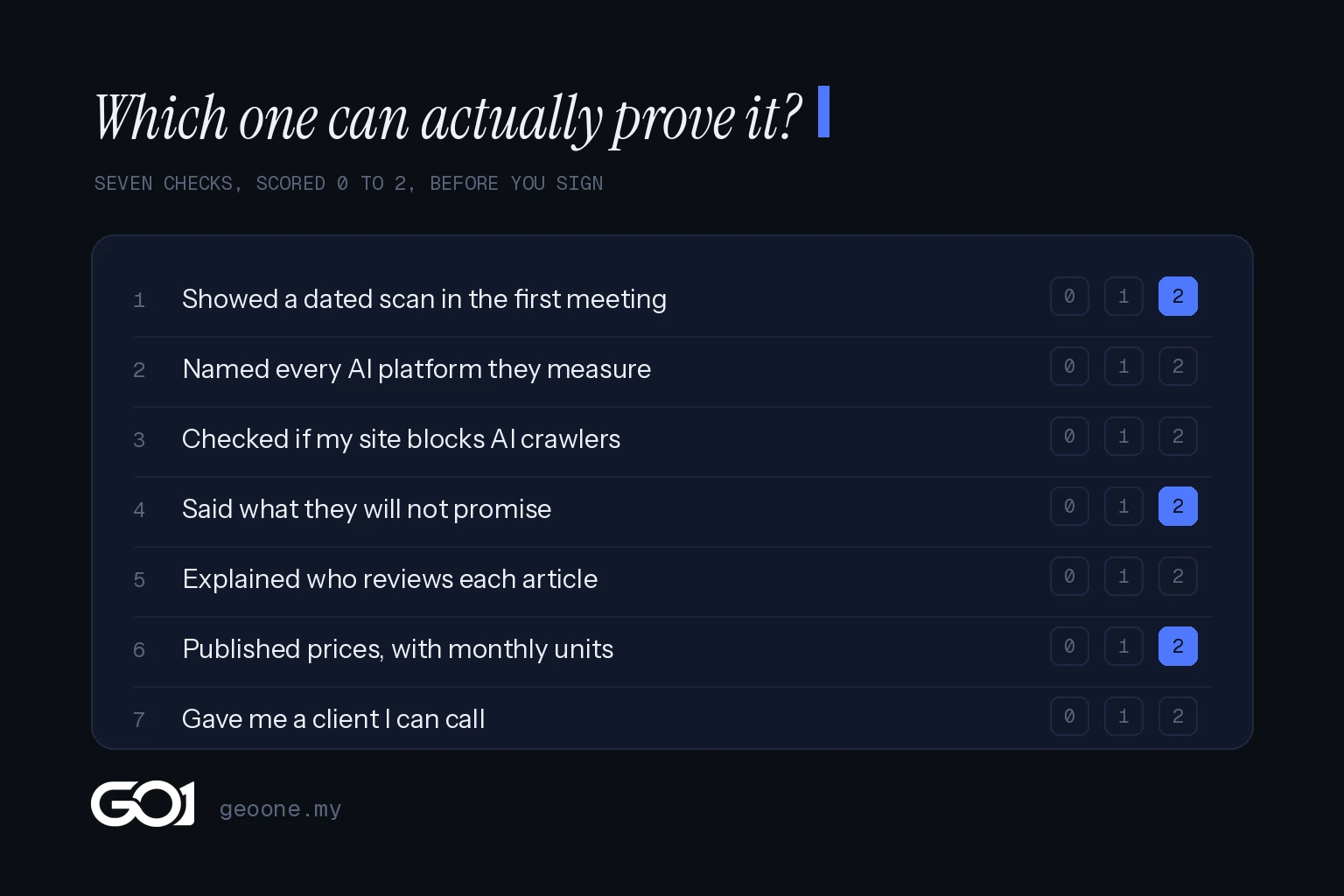
A GEO agency in Malaysia should be able to do four things before you pay it anything: show you a dated scan of how ChatGPT, Claude, Gemini, Perplexity and DeepSeek currently answer questions in your category; explain which specific questions you are absent from; publish its prices; and tell you plainly what it cannot promise. Most cannot do all four. This guide covers what GEO actually involves, seven things to check, the red flags that separate real AI visibility work from repackaged SEO, and what it costs.
It is written by Geo One, which is one of the options. Where we describe ourselves we use our own published numbers and name our own gaps, so you can judge the rest of the guide against them.
What a GEO agency actually does
Generative Engine Optimisation is the work of making a business discoverable, understandable and citable by AI assistants. The difference from SEO is not cosmetic. Google returns a list; you can be tenth and still get clicks. ChatGPT returns an answer; you are either in it or you are not. Being on page one of Google says nothing about whether an AI assistant names you, and in our scans the two are often unrelated.
The work, done properly, has four parts, and a serious agency should be able to describe each in concrete terms.
- Measurement. Testing the real questions your customers ask AI, recording which businesses are named, which answers cite a source, and where you appear or do not. This has to be repeated on a schedule with timestamps, or nothing else can be evaluated.
- Website and entity work. Schema markup, clear statements of what the business is and where it operates, consistent details across directories, and an llms.txt file. This is the part that overlaps with technical SEO, and the part most agencies already half-understand.
- Content that answers the actual questions. Not keyword articles. Direct, specific answers to the prompts that came out of measurement, structured so an AI system can lift them.
- Third-party signals. Directory listings, media mentions and citations on other sites. AI platforms weigh these heavily, and no amount of on-site work substitutes for them.
If an agency describes GEO as “SEO for AI” and stops there, it has not done it.
Seven things to check before you sign
1. Ask for a scan, with a date on it
This is the single most useful question you can put to any agency in this category. “Show me how AI platforms currently answer questions about my industry, and show me when you ran it.” An agency doing real GEO work will have a tool that produces this in minutes and will be glad to show you, because it usually reveals that you are invisible, which is the sale. An agency that has added GEO to its services page will change the subject.
Geo One runs a free scan that anyone can use without speaking to us. Whoever you are evaluating, run it first; it gives you a baseline to hold every agency against.
While they have your site open, ask one more thing: is it currently blocking AI crawlers? A surprising number of Malaysian sites are, without knowing it. Cloudflare has a one-click setting that rewrites robots.txt to block GPTBot, ClaudeBot and Google-Extended, and some hosting providers switch it on by default. If it is on, nothing else an agency does will matter until it is off. An agency that does not check this before quoting is not looking at the thing that decides everything.
2. Ask which platforms they actually measure
“AI visibility” can mean ChatGPT alone, or it can mean four or five platforms. Ask for the list. Then ask whether each one is measured or merely mentioned. Geo One scans ChatGPT, Claude, Gemini, Perplexity and DeepSeek today, and each client picks four of those five to track. Kimi is announced and tested but not yet measured, and we say so on every page rather than counting it in our coverage. An agency that cannot make that distinction about its own coverage will not make it about your results.
3. Ask them to explain what they will not promise
No provider controls what an AI platform says. The platforms generate their own answers, update their models, and change their sources without notice. A position won in March can be gone in May. A credible agency will tell you this unprompted, because it is the most important thing to understand before spending money. If you have to drag it out of them, or if the answer is a guarantee, walk away.
What can honestly be committed to: the volume of work, the review standard applied to it, and a scan every month with a timestamp you can verify. That is what Geo One commits to, and it is the ceiling of what anyone can.
Ask, too, where you will see the effect in tools you already own. Google added a Generative AI performance report to Search Console in June 2026, showing impressions from AI Overviews and AI Mode separately. It is rolling out gradually and not every account has it yet, but an agency that does not know it exists is behind on the one free source of truth you will have.
4. Ask who reviews the content and how many times
Most GEO content is now drafted by AI systems, including ours. That is not the problem. The problem is content that goes from a model to your website with nobody reading it. Ask which editorial checks each article gets, what each check covers, and whether you approve everything before it publishes. Ask to see a draft that was rejected and why.
Every Geo One article gets an editorial and factual check; Silver adds GEO specialist checks and Gold adds a senior sign-off. Every piece needs your approval before it goes live. We publish what each check covers, because the difference between plans is mostly this, not the word count.
5. Ask for the price
Published pricing is still unusual in Malaysian marketing, and its absence is informative. An agency that prices every client differently is pricing on what it thinks you will pay. Geo One publishes its rates: a one-time RM1,000 Foundation Setup, then RM500, RM1,000 or RM2,000 a month, at introductory rates that rise to RM1,200, RM2,500 and RM4,800 from January 2027. We also publish that the minimum term is six months, and why: AI visibility compounds, and six months is the shortest period in which the work can be honestly judged.
Whatever the number, ask what it buys per month in concrete units: articles, FAQs, tracked prompts, scans. If the answer is a retainer with no units, the agency is selling hours, not outcomes it can measure.
6. Ask who owns the work when you leave
Content published on your website should remain yours after the engagement ends. Some agencies host content on their own properties, or on subdomains they control, which means the visibility leaves with them. Ask directly: if we stop paying, what stays on our site?
7. Ask for a reference you can call
Not a logo wall. A person, at a named business, who will talk to you. If the agency is new, it should say so and offer what it has. Geo One has one published reference client, Omega Pets, whose founder is quoted with permission on our site. We say “one” on the site itself because we would rather you hear it from us.
Red flags
These are the patterns we see most often when businesses come to us after a first attempt somewhere else.
- A guaranteed ranking, citation or recommendation. Nobody controls the platforms. This one ends the conversation.
- “Results in 30 days.” Some businesses do see mentions that fast. Promising it in advance is a different thing.
- No scan, or a scan without a date. A screenshot of ChatGPT naming a client proves nothing about when, how often, or under what prompt.
- Case studies with percentages and no base. “300% increase in AI mentions” from one mention to three is technically true.
- GEO as a line item on an SEO package. The technical overlap is real, but the measurement is entirely different, and an agency that has not built the measurement has not built the service.
- A refusal to discuss what happens if it does not work. It sometimes does not, or takes longer than anyone wanted. The honest answer is a conversation about what the scans showed and what to change.
What it costs in Malaysia, and what you should expect for it
We can only speak to our own pricing, because almost nobody else publishes theirs. At Geo One, every plan includes the same twelve services; what changes between Bronze, Silver and Gold is publishing volume, how many AI engines are monitored, the model capability behind the drafting, research depth, and which editorial checks each article gets. Bronze tracks 6 prompts across 3 engines, 18 tests a scan. Gold tracks 33 across 5 engines, 165 tests a scan. ChatGPT and Claude are on every plan; the rest you choose.
Used as a benchmark against another agency’s quote, the useful questions are: how many prompts are tracked, how often are they scanned, how many pieces of content ship a month, and how many people read each piece before it publishes. Compare those, not the headline retainer.
Where Geo One fits, honestly
Geo One is a Kuala Lumpur company registered as GEO ONE AI SOLUTION (SSM 202603214063), founded by Bernard Leong and Jeremy Chew, and built on Pexalo, an AI automation platform that also builds agents for businesses outside GEO. The work is executed by sixteen AI Employees with named people owning strategy and editorial review, and the site is published in English, Chinese and Bahasa Malaysia.
What we have: a scanner anyone can use, published pricing, a published methodology, and one dated result. Omega Pets, a Malaysian pet care brand, moved from 0 to 30 out of 100 in two weeks after the audit, first website fixes and first content, on a scan of 36 answers across four platforms dated 22 August 2026. Six prompts reached first position or were cited. Twenty-five of the thirty-six answers still did not cite the site, and Claude and Perplexity returned the brand far less often than ChatGPT and Gemini. That is where a real result sits at two weeks.
What we do not have: a long client list, a track record across many industries, or any way to promise you what the platforms will say. We are young and we say so. If that rules us out, the seven checks above will still serve you with whoever you choose.
A scorecard you can take into the meeting
Score each agency 0, 1 or 2 on every line. Anything under 9 out of 14 is a no.
- Showed a dated scan of my category in the first meeting
- Named every AI platform they measure, and which they only mention
- Checked whether my site blocks AI crawlers before quoting
- Said plainly what they will not promise, without being asked
- Explained who reviews each article and how many times
- Published prices, with monthly units of work
- Gave me a client I can call
Frequently asked questions
What is a GEO agency?
A GEO agency (Generative Engine Optimisation agency) works to make a business discoverable, understandable and citable by AI assistants such as ChatGPT, Claude, Gemini, Perplexity and DeepSeek. Where an SEO agency optimises for a ranked list of links on Google, a GEO agency optimises for being named or cited inside a generated answer. The core work is testing real customer questions against AI platforms, fixing website structure and entity signals, publishing content that answers those questions directly, and earning third-party mentions that AI systems treat as trust signals.
How much does GEO cost in Malaysia?
Published Malaysian pricing is still rare. Geo One publishes its rates: a one-time RM1,000 Foundation Setup, then Bronze at RM500, Silver at RM1,000 and Gold at RM2,000 a month at introductory rates, with a 6-month minimum term. Standard rates from 1 January 2027 are RM1,200, RM2,500 and RM4,800. Any agency that will not put a price on its website should be asked why.
Can a GEO agency guarantee that ChatGPT will recommend my business?
No, and one that says otherwise is the clearest red flag in the category. AI platforms generate their own answers and change constantly, and a position won can be lost. What a credible agency commits to is the work, the review standard, and a timestamped scan every month that you can check yourself.
How long does GEO take to show results?
Timing varies by industry, competition and how quickly content is approved. Some businesses see named mentions within weeks; others take months. Geo One's one published client, Omega Pets, moved from 0 to 30 out of 100 in two weeks on a 36-answer scan, with 25 of those 36 answers still not citing the site. Six months is the shortest honest window in which to judge the work, which is why it is the minimum term.
Is GEO the same as SEO?
No. SEO earns a position in a list of links; GEO earns a mention inside a generated answer. They overlap in technical foundations such as site structure and schema, but the measurement, the content approach and the definition of success are different. A business ranking on page one of Google can be entirely absent from ChatGPT's answer to the same question.
Should I choose a specialist GEO agency or a digital marketing agency that offers GEO?
Ask either one the same question: show me a scan, with a date, of how AI platforms currently answer questions in my category. A specialist will have a tool and a method for this. An agency that has added GEO to a services page will usually not. The label matters less than whether they can measure the thing they are selling.
Start with the scan
If you want names, our ranking of ten Malaysian GEO agencies puts published prices, terms and measurement side by side. Whichever agency you end up with, begin with a baseline you did not pay for. Run the free AI visibility scan, keep the result, and hold every proposal against it. If you would like to talk to us afterwards, get in touch. If you would not, the scan is still yours.

Bernard Leong
Co-Founder, Geo One
Nearly 20 years across energy, capital strategy and applied AI, including large-scale operational data at BP. Founded SkillsMe and Cryptrain.
More about the teamCheck Your AI Visibility
See how AI platforms currently view your business with a free scan.
Free AI Scan