How to Choose an AI Visibility Agency in Kuala Lumpur: Four Checks to Run First

Co-Founder, Geo One
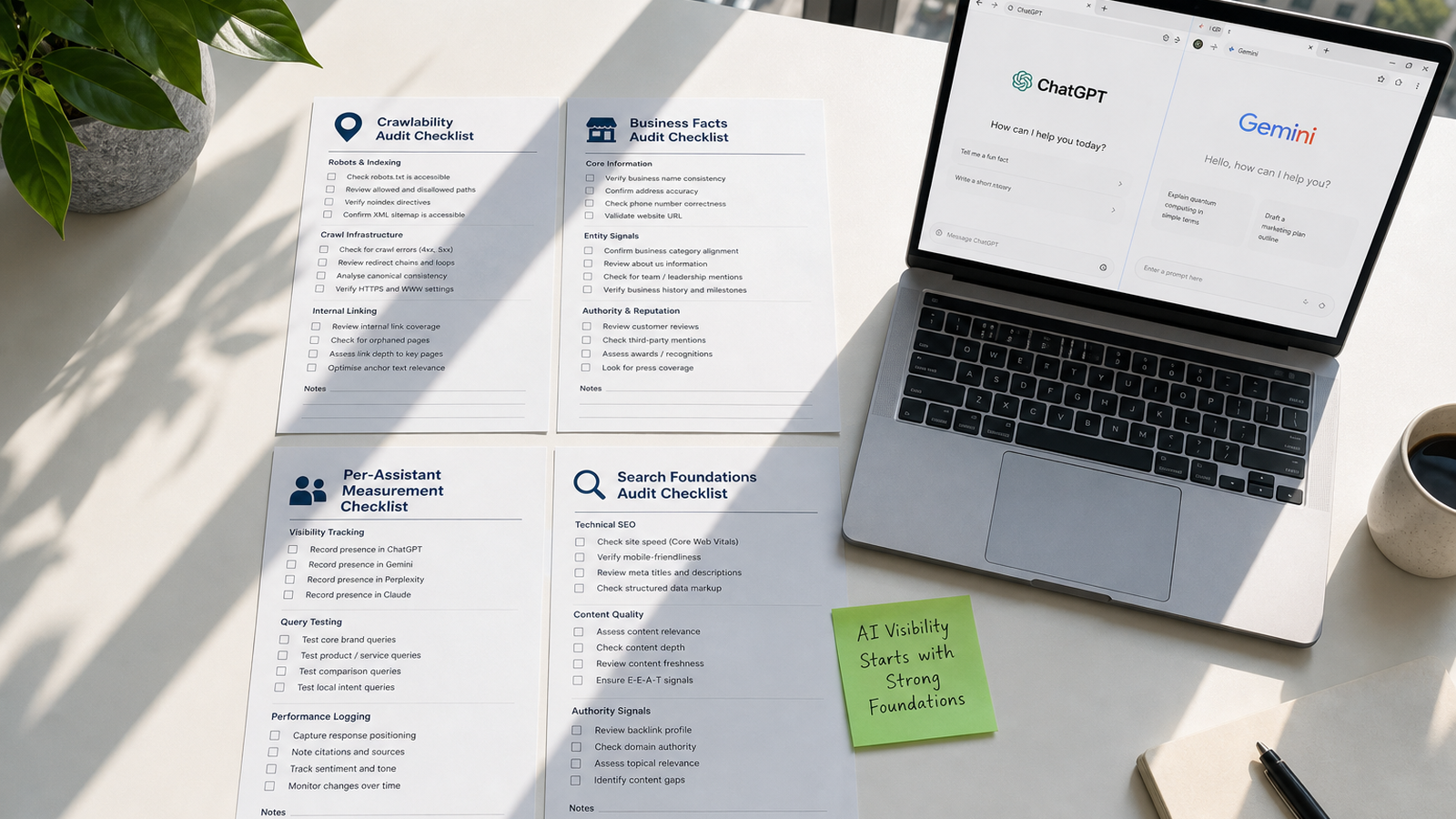
Many AI visibility agencies in Kuala Lumpur sell the idea of being easier for ChatGPT, Claude, Gemini or Perplexity to understand and potentially surface. A credible agency should be clear that no one can guarantee recommendations, citations or rankings inside AI answers. What separates them is what they check before they take your money. Four checks. Can AI crawlers reach your website? Do your business facts match across SSM, Google and your own pages? Are they measuring each assistant separately? And are they building on real search foundations, or selling an AI-only shortcut?
You can run all four yourself in an afternoon. If an agency's pitch doesn't survive them, you have saved yourself a retainer.
This is written for professional services firms in the Klang Valley — law and accounting practices, clinics, dental and veterinary surgeries, consultants and agencies with 2 to 50 staff and nobody in-house who owns marketing.
What an AI visibility agency actually does
Generative engine optimisation (GEO) is getting your business named inside AI-generated answers. Answer engine optimisation (AEO) is structuring your content so an assistant can lift a clean, correct answer straight out of it. Both sit on top of normal search work; neither replaces it.
In practice the job is unglamorous: schema, consistent business facts, content that answers the questions your buyers actually type, then checking repeatedly whether the answer has changed. Models get updated without announcement.
Check one: can AI crawlers reach your site at all?
If your website blocks the crawlers AI companies use, your own site becomes much harder for those systems to access and verify, so schema, content and FAQ work may have less impact. Check it in two layers, because passing the first tells you nothing about the second.
Layer one, robots.txt. Type your domain followed by /robots.txt into a browser. Look for GPTBot and OAI-SearchBot (OpenAI), ClaudeBot (Anthropic), PerplexityBot, Google-Extended and CCBot. A blanket Disallow: / under any of those is a decision someone made, usually years ago, usually your web developer.
Layer two, the edge. A site can permit GPTBot in robots.txt and still return a 403 to it at the firewall. Robots.txt is a request; a WAF rule is a wall. Checking this means reading server logs for those user-agents, or fetching a page while presenting one. Most audits never get past layer one.
Cloudflare, which sits in front of many Malaysian SME websites, may have separate controls covering different crawler types. Check your own dashboard and the current Cloudflare documentation on AI crawler controls before changing any settings, as defaults and options can vary by account type.
Ask any agency pitching you: before you sell me anything, will you check my crawler access at both layers and show me the result? If they look blank, that tells you what you need to know. You can run a free AI visibility scan to see where you currently stand.
Check two: do your business facts match everywhere?
AI assistants build a picture of your business by cross-referencing sources. When public sources disagree, AI assistants may have less confidence in which business details to use. You can audit this yourself today.
Open six tabs: SSM e-Info, your Google Business Profile, your professional body's public register (the Bar, MIA, the relevant medical or veterinary council), your LinkedIn company page, your website footer, and whichever local directory ranks when you search your own firm name. Put four things side by side — legal name, address, phone, services — and mark every disagreement.
What you will usually find: SSM carries the full legal name, Google carries a shortened trading name, the footer carries a third version with a suite number from before you moved. The address reads "Jalan" in one place and "Jln" in another, with the unit written as A-3-7 here and Lot 3-7 there. A directory lists a landline that now rings in an empty room.
In Geo One audits, inconsistent entity data is often treated as a priority risk for AI visibility, even where the business still ranks in traditional search. Entity work — making your business a single, consistent, machine-readable thing across every source — is the least exciting part of GEO and usually the highest-return. Ask an agency to show you their entity audit format before you sign. If they can't produce one, they're doing content, not GEO.
Check three: are they measuring each assistant separately?
Test it yourself before you brief anyone. Write down ten questions a real buyer would ask — not "best law firm Malaysia" but "who can handle a tenancy dispute in Mont Kiara" or "dentist open Sunday Cheras". Ask all ten in ChatGPT, Claude, Gemini and Perplexity. Ask the three most valuable ones again in Bahasa Malaysia. Record three separate outcomes each time: were you named, were you cited with a link, and who was named instead. That last column is the useful one, and the one most agency reports leave out.
Do it again next week. If your results move without anyone touching your site, you have just learned why a one-off project doesn't hold.
We can't promise placement in any assistant — be wary of anyone who does. What we can do is show you the same question set week after week, so you can see the direction of travel. See what our reporting looks like before you commit.
Check four: shortcuts or foundations?
Google has published guidance on how content earns features in AI-powered search; refer to Google Search Central and Google's AI Overviews documentation for current detail. The consistent message is that the same foundations that support organic search support AI visibility.
Google has also clarified that its spam policies cover attempts to manipulate generative AI responses in Search; see Google's spam policies for current guidance. On that basis, citation farming carries the same demotion risk as link spam.
The practical takeaway: if the pitch involves a proprietary file, a special tag or a batch of new mentions appearing quickly on sites you've never heard of, ask what happens when Google's next spam update lands. Legitimate work is slower and duller. It survives.
What it costs and what the first month looks like
Month one is diagnosis, not miracles: crawler access at both layers, entity consistency, schema, and a baseline across all four assistants on your tracked questions — then the fixes, in order of what is actually blocking you.
On evidence: our client Omega Pets, a pet care brand in Selangor, moved from an AI visibility score of 0 to 30 between 8 and 22 August 2026. That figure comes from our own scanner, not an industry-standard metric. The score reflects the share of tracked prompts in which the business was named or cited across ChatGPT, Claude, Gemini and Perplexity, using a defined prompt set in English, tested with non-branded queries, and rescanned at the end of the period to confirm the improvement held. It is one client over one fortnight — a starting point rather than a finished result. Full pricing is published here, no call required to see it.
What Geo One does not do
We don't build back-office automation, workflow tools or chatbots. We don't guarantee that any assistant will recommend you, because nobody controls what a model outputs. We don't publish anything to your site without your approval. And we won't take a retainer from a firm whose real problem is that its website has no content worth citing — we'll say so, and quote for fixing that first.
Run the four checks yourself. If you'd rather see the results in writing across all four assistants, get in touch with Geo One.
Frequently asked questions
Can an AI visibility agency guarantee my business shows up in ChatGPT or Google AI answers?
No agency can guarantee recommendations, citations or rankings inside AI answers. The article is explicit that nobody controls what a model outputs, and it advises being wary of anyone who promises placement in any assistant. A credible agency will be upfront about this limitation and focus instead on measurable foundations like crawler access, consistent business facts and structured content.
How do I check if AI crawlers like GPTBot can actually access my website?
Check in two layers. First, type your domain followed by /robots.txt into a browser and look for GPTBot, OAI-SearchBot, ClaudeBot, PerplexityBot, Google-Extended and CCBot. Second, check your firewall or WAF, because a site can allow a crawler in robots.txt but still block it with a 403 at the server level. Most audits only cover the first layer, which can give a false sense of access.
Why does it matter if my business name is written differently on SSM versus Google versus my website?
When public sources disagree on your legal name, address, phone or services, AI assistants may have less confidence in which details to use when building a picture of your business. The article describes inconsistent entity data as a priority risk for AI visibility, often higher-return to fix than content work, even when the business still ranks in traditional search.
How do I test whether my firm is being named in AI assistant answers right now?
Write ten questions a real buyer would ask, then ask all ten in ChatGPT, Claude, Gemini and Perplexity. For each response record three things: whether you were named, whether you were cited with a link, and who was named instead. Also test the most valuable questions in Bahasa Malaysia. The article suggests repeating this the following week, since results can change without anyone touching your site.
What does the first month of AI visibility work actually involve?
Month one is described as diagnosis rather than results: checking crawler access at both layers, auditing entity consistency across sources, implementing schema, and establishing a baseline across all four assistants on your tracked questions, followed by fixes in order of what is actually blocking visibility. The article references a client, Omega Pets, whose AI visibility score moved from 0 to 30 between 8 and 22 August 2026, measured on the agency's own scanner.
What should I be cautious about if an agency pitches a fast or proprietary method for AI citations?
The article warns that citation farming carries the same demotion risk as link spam under Google's spam policies, which cover attempts to manipulate generative AI responses in Search. If a pitch involves a proprietary file, a special tag or a batch of new mentions appearing quickly on unfamiliar sites, you should ask what happens when Google's next spam update lands. Legitimate work is described as slower and duller, but able to survive updates.

Bernard Leong
Co-Founder, Geo One
Nearly 20 years across energy, capital strategy and applied AI, including large-scale operational data at BP. Founded SkillsMe and Cryptrain.
More about the teamCheck Your AI Visibility
See how AI platforms currently view your business with a free scan.
Free AI Scan