
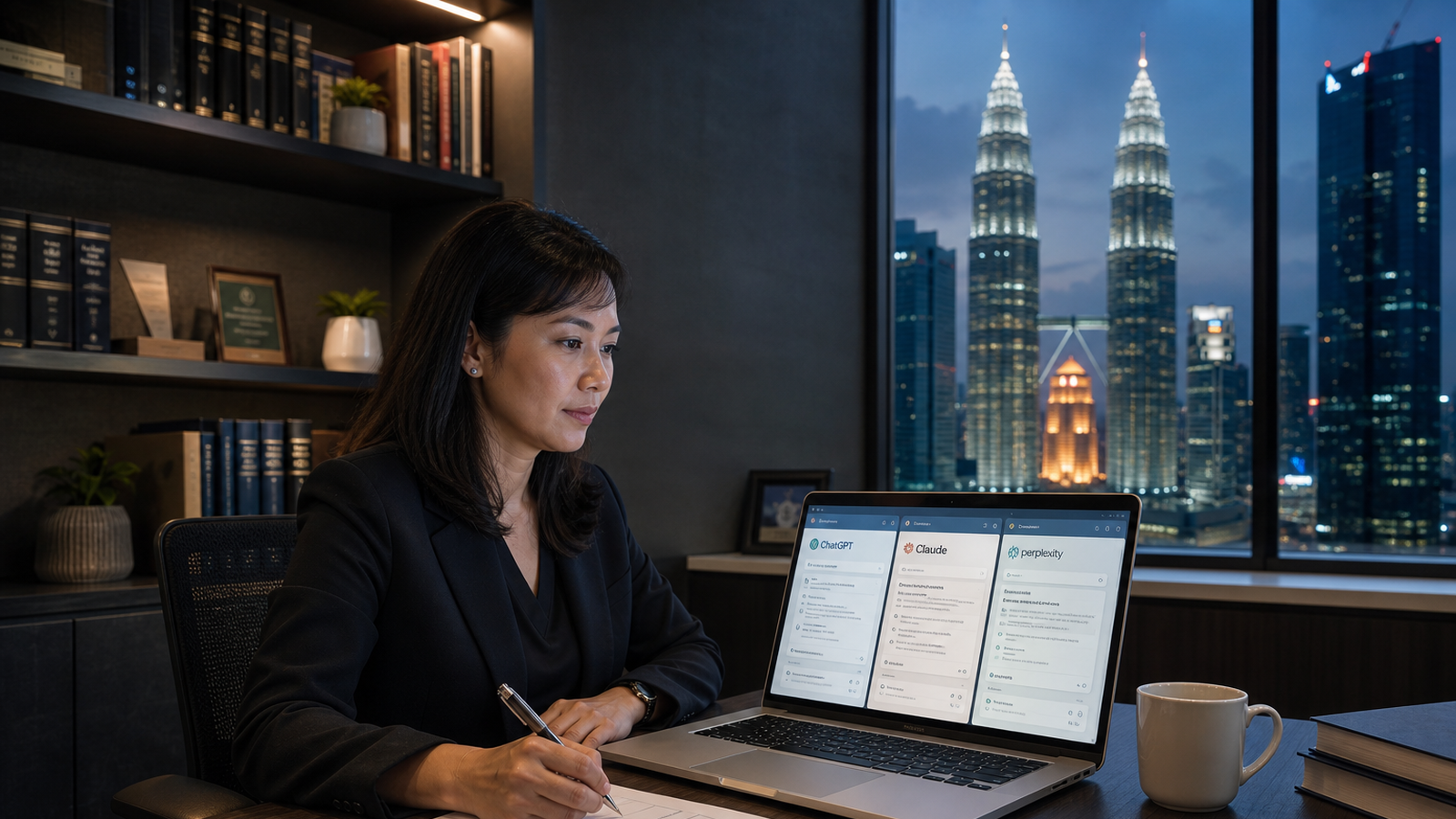
Bahasa Malaysia prompts in GEO reporting: what Kuala Lumpur SMEs should track
A GEO report that only tracks English prompts shows you part of what buyers see. Track the same buyer question three times: once in English, once in Bahasa Malaysia, and once in Mandarin if that is how your clients enquire. For each run, log the engine, whether your business was named, whether the description was accurate, which other businesses were named, and which source the answer cited.
That is the method. The rest of this piece gives you the sector prompts, a blank logging sheet, and the fixes worth trying when the Malay answer comes back thin.
This is written for Klang Valley professional services firms, law and accounting practices, clinics, dental and veterinary surgeries, tuition centres and property agencies, with 2 to 50 staff and no in-house marketing owner.
The assumption that costs you: buyers often ask AI in a different language than they speak to you
Most KL firms decide their language mix from their client base. "Our patients speak English, so English is what matters." That reasoning holds for your reception desk. It does not automatically hold for AI search.
The language someone uses to talk to you and the language they use to find you are often two different choices. A parent who conducts the whole tuition enrolment in English may still type "pusat tuisyen Matematik SPM Shah Alam" into an assistant, because that is the phrasing that matches how the exam, the syllabus and the school system are named. A patient who consults in English may still search "klinik keluarga buka hujung minggu" because that is the everyday term. Vocabulary tends to follow the subject, not the speaker.
We can't tell you how large that effect is for your practice, and neither can anyone else without running it. That is the point: the decision to skip Malay-language tracking is usually made on the wrong evidence. Run the prompts before you decide the language doesn't matter.
What should a GEO report track for Bahasa Malaysia prompts?
Five fields per prompt, every time.
- Language. English, Bahasa Malaysia and Mandarin logged as separate rows, never merged into one score.
- Engine. ChatGPT, Claude, Gemini and Perplexity recorded separately, because they pull from different sources and return different answers to the same question.
- Named. Was your business mentioned? Yes or no.
- Accurate. If named, was the description correct, right services, right area, no outdated detail?
- Source cited. Which URL or publication did the engine attribute the answer to?
Language is a row, not a column. Merging languages or engines into a single visibility score hides the gaps. A clinic in Petaling Jaya might appear clearly in English ChatGPT answers and not at all in Bahasa Malaysia Gemini answers. Those are two different problems with two different fixes, and a blended score of "62%" tells you neither.
If you're new to the four-engine part of this, treat language as a layer on top of it rather than a replacement, our piece on judging an agency by four-engine coverage rather than one score covers that base methodology.
Log the exact string, not the topic
Malay gives you more than one correct way to name the same service. Peguam and firma guaman. Doktor gigi and klinik pergigian. Hartanah and harta tanah. Pusat tuisyen and kelas tambahan.
We treat those as separate retrieval events rather than synonyms, an operating assumption, not a measured finding. Your own log will confirm it or kill it within two months, which is a better answer than ours.
Register matters too. Formal Malay ("khidmat guaman untuk kontrak perniagaan") and how someone actually types on a phone ("nak cari peguam kontrak kat KL") are not the same string. Neither is code-switched Manglish, "klinik gigi near Cheras", which is common in the Klang Valley and almost never appears in anyone's prompt list.
Practical rule: pick two phrasings per service, one formal and one colloquial, and keep both in the set permanently. Record the prompt verbatim in your sheet. If you paraphrase it next month, you've lost your baseline.
Why Bahasa Malaysia prompts return thinner answers
AI engines answer from what they can find. If your website, your Google Business Profile and any third-party mentions of your practice are in English only, Malay-language queries have less to retrieve.
The engine then falls back on whatever Malay-language material does exist, which tends to be large chains, franchises and directory aggregators.
The fix isn't translation for its own sake. It's making sure factual content about your business exists in Bahasa Malaysia somewhere a crawler can reach: your website's service pages, your Google Business Profile description, or directory listings that rank in Malay search.
Before you blame the language, check the crawlers can reach you
A thin Malay answer isn't always a language problem. If AI crawlers can't fetch your site, no version of your content is retrievable in any language.
Cloudflare announced in 2025 that it would block AI crawlers by default for newly onboarded domains, and gave existing customers a one-click control to do the same. Plenty of Malaysian SMEs sit behind Cloudflare through their web host without ever having chosen a setting. Other CDNs, security plugins and hosting panels offer similar switches.
So check your robots.txt and your CDN's bot rules before you write a single Malay page. If GPTBot, ClaudeBot, PerplexityBot or Google-Extended are blocked, that's the first fix, and no amount of Bahasa Malaysia content will substitute for it. The wider picture is in our write-up on what changed in GEO in 2026.
Sector prompts worth running
These are written as a buyer would type them. Run each in all three languages, across all four engines, and log the five fields above.
Law and accounting firms
- "Firma guaman untuk kontrak perniagaan di Kuala Lumpur"
- "Akauntan untuk syarikat SME di Petaling Jaya"
Clinics and dental practices
- "Klinik keluarga berdekatan Cheras yang buka hujung minggu"
- "Doktor gigi untuk rawatan ortho di Klang Valley"
Tuition centres
- "Pusat tuisyen Matematik SPM di Shah Alam"
- "Kelas Bahasa Inggeris untuk pelajar UPSR di Subang"
Property agencies
- "Ejen hartanah untuk apartment di Mont Kiara"
- "Cara jual rumah teres di Puchong dengan cepat"
Run the same prompts in English and, where relevant, Mandarin. Differences between the answers tell you where your Bahasa Malaysia content is thin.
Be aware of the workload before you commit to it. Two prompts, three languages, four engines is 24 runs a month for one sector, and two prompts is a thin set. A realistic list of six to eight prompts puts you between 72 and 96 runs, every month, logged consistently enough to compare. That's the honest reason most firms either buy this or stop doing it by month three.
The logging sheet
Copy this as a spreadsheet. One row per prompt per engine per language run.
| Date | Prompt (verbatim) | Language | Engine | Named (Y/N) | Description accurate (Y/N) | Competitors named | Source cited |
|---|
Run the same prompt set monthly. Changes in the Named column over time are the signal worth watching.
Which gap to fix first
Not the language your customers speak, the language where your competitors are named and you are not.
Being fourth-named in an English answer is a ranking problem. Being absent from a Malay answer that names three competitors is an availability problem, and availability is usually cheaper to fix than rank. Sort your log by the rows where Named = N and the Competitors named column is full. Start there.
What to do when the Malay answer is thin
If your business doesn't appear in Bahasa Malaysia answers but does appear in English answers, the gap is usually one of three things.
Missing Malay-language content. Add a Bahasa Malaysia version of your key service pages. It doesn't need to be a full site translation. A single page describing what you do, where you are and who you serve, written in Bahasa Malaysia, gives engines something to retrieve.
Google Business Profile description in English only. The description field accepts Bahasa Malaysia. Rewrite it, or add a Malay-language version where the platform allows it.
No third-party Malay-language mentions. If local directories, news sites or community forums have written about businesses like yours in Malay and none of them mention you, that's a content gap. Getting listed or cited in Malay-language sources gives engines a corroborating signal.
None of these fixes controls what an engine surfaces, no agency does, and anyone promising otherwise is selling you something they can't deliver. What the fixes do is improve the signals those engines have available when a Malay-language query comes in.
Geo One is a GEO and GEO agency based in Kuala Lumpur, serving SMEs and solo professionals across the Klang Valley. Related reading on our blog: four-engine coverage versus single-score reporting, and what changed in GEO in 2026.
Work with Geo One: explore our services or get in touch to get started.
Frequently asked questions
Is tracking English prompts enough for AI visibility in Malaysia?
No, an generative engine optimisation report that only tracks English prompts shows you part of what buyers see. Run the same buyer question three times: once in English, once in Bahasa Malaysia, and once in Mandarin if that is how your clients enquire. Each run can return a different answer, name different businesses and cite a different source, so all three need logging.
What should be recorded for each prompt in an AEO report?
For every run, log the language, the engine used, whether your business was named, whether the description of your business was accurate, which other businesses were named, and which source the answer cited. That is the whole method. Keeping these fields consistent every time is what makes the report comparable month to month rather than a collection of screenshots.
Can Bahasa Malaysia and English results be combined into one visibility score?
No, English, Bahasa Malaysia and Mandarin should be logged as separate rows and never merged into one score. Merging hides the case where your firm is named in English answers but missing from the Malay ones. Separate rows show you exactly which language is weak so you know where the fix is needed.
Which AI engines should my agency be checking?
ChatGPT, Claude, Gemini and Perplexity, each recorded separately, because they do not source answers the same way. One engine may name your firm while another names a competitor for the identical question. A single combined figure across engines tells you little about where your business is actually missing.
Is this kind of language tracking relevant to a small firm like mine?
This approach is written for Klang Valley professional services firms with 2 to 50 staff and nobody in-house who owns marketing. That includes law and accounting practices, clinics, dental and veterinary surgeries, tuition centres and property agencies. The logging sheet is deliberately simple so a small team can keep it going without a marketing specialist.
What can I do if the Bahasa Malaysia answer comes back thin?
The article sets out fixes worth trying once your log shows the Malay answer is thin, alongside the sector prompts to test and a blank logging sheet you can copy. The first step is always the log itself: you need to see which engine, which language and which cited source produced the weak answer before choosing a fix.

Bernard Leong
Co-Founder, Geo One
Nearly 20 years across energy, capital strategy and applied AI, including large-scale operational data at BP. Founded SkillsMe and Cryptrain.
More about the teamCheck Your AI Visibility
See how AI platforms currently view your business with a free scan.
Free AI Scan