Does Google AI Overviews visibility carry into ChatGPT?

Co-Founder, Geo One
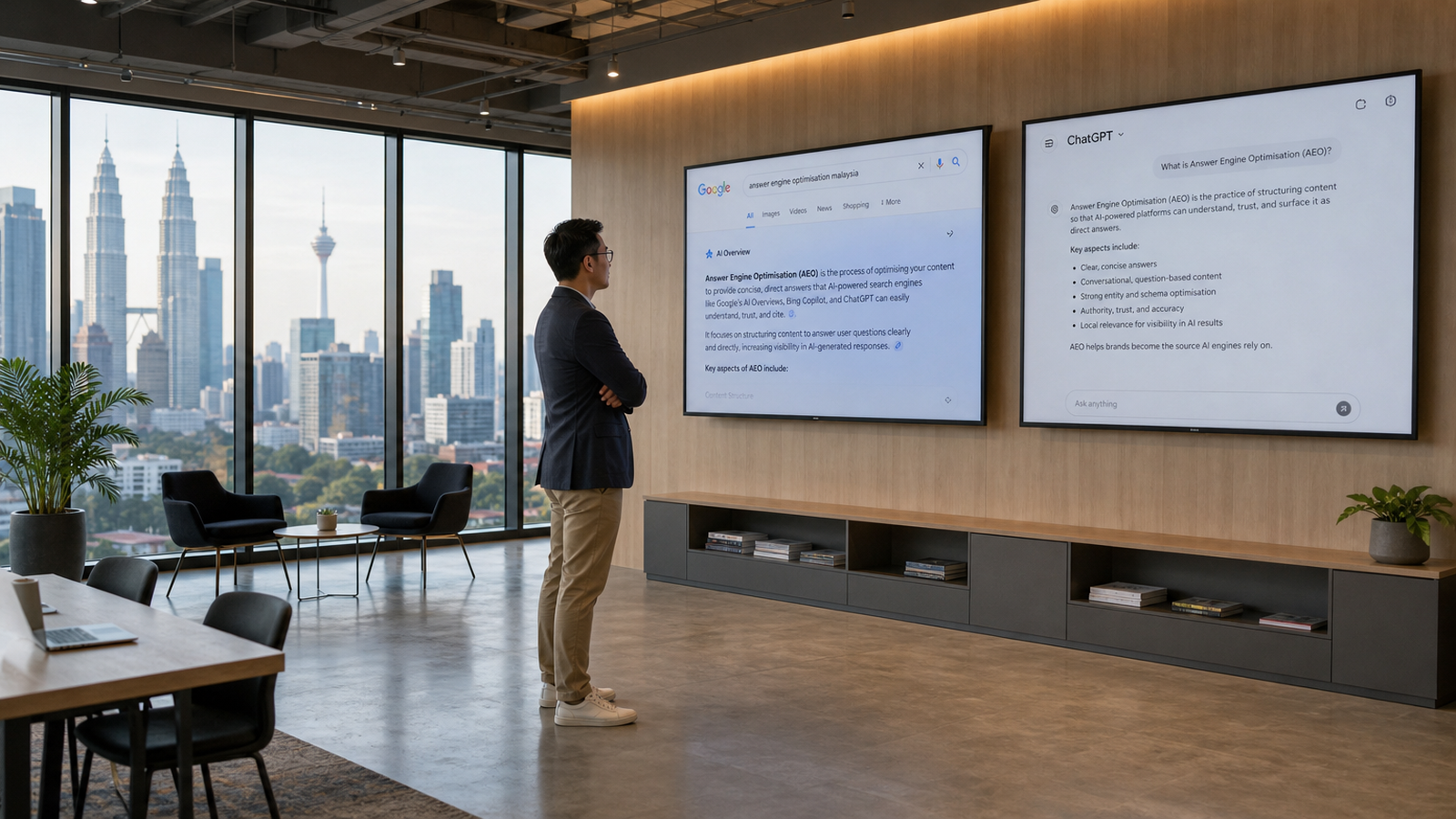
Short answer: mostly no. Independent overlap studies keep finding that the domains ChatGPT cites and the domains Google AI Overviews cite are largely different sets, and our own scans show the same split. So if your accounting firm shows up in a Google AI Overview, that tells you very little about whether ChatGPT names you when a buyer asks the same question. The two read from largely separate pools of sources. Winning one is a different piece of work from winning the other, and, as it turns out, the two jobs run on different clocks.
This is written for owners and practice managers of Klang Valley professional services firms with 2 to 50 staff. Disclosure: it comes from Geo One, a Generative Engine Optimisation (GEO) and Answer Engine Optimisation (AEO) agency in Kuala Lumpur.
Why don't ChatGPT and Google AI Overviews cite the same pages?
Because they have different source habits, and the gap widens exactly where buyers ask the questions that matter.
On open-ended discovery questions, the sort a buyer types when shortlisting, the overlap is smallest: most of the pages AI Overviews leans on never appear in ChatGPT's answer to the same question. What overlaps more is the brand names. The engines often agree on who the players are while disagreeing completely on whose page to read.
The reason is visible in what each one leans on. ChatGPT reaches often for Wikipedia and reference-style pages, while AI Overviews draws more heavily on vendor pages and community platforms such as Reddit. Different source types reward different signals.
One more piece worth knowing: AI Overviews still tracks Google's own rankings far more closely than ChatGPT does. The pages it cites are increasingly the ones already in Google's top ten, while ChatGPT's picks bear little relation to that list. That is an association, not proof of cause. But it suggests Search Engine Optimisation (SEO) work may still carry you on the Google surface and do very little on the ChatGPT one.
What should you check before changing anything?
Three checks, in this order, because each one makes the next meaningful.
One: can each crawler actually reach you? Different assistants send different crawlers, and a firewall rule or a bot setting can block one while letting another through. OpenAI documents its crawler behaviour in the OpenAI bots page, Anthropic documents ClaudeBot in its crawler note, and if you sit behind a content delivery network, the controls are described in the Cloudflare bot docs. Check the current pages rather than trusting a setting someone configured a year ago.
Two: do your facts match everywhere? Name, address, phone, opening hours, services, practitioner names, on your own site, your Google Business Profile, and every directory you appear in. When an assistant finds three versions of your clinic's opening hours, it has no reason to prefer yours. Our walkthrough on how to audit your Google Business Profile for AI visibility covers that side properly.
Three: ask the questions and write down the answers. Not your traffic report. Analytics only shows the engines that label themselves, which is why monitoring only ChatGPT is not enough. The only reliable method is to put the buyer's question into each assistant and record what comes back.
Which work moves which engine?
Google AI Overviews rewards things you control on your own property. Clean, crawlable pages. Structured data using the types published at Schema.org, so a machine can read that you're a dental practice in Cheras rather than guessing from the page title. Direct answers near the top of the page, in the words a buyer uses. A Google Business Profile that is accurate and active. Google publishes confirmed changes to its Search and AI features on the Google Search Central blog, which is worth watching rather than relying on secondhand summaries.
ChatGPT depends far more on what other people have published about you: reference pages, industry publications, professional bodies, genuine directory listings in your category, write-ups that are not on your own domain. You can't edit those. You earn them, and they take months. This is why a firm can rank respectably on Google and still be absent from ChatGPT: nobody outside its own website has written anything verifiable about it.
Perplexity and Claude behave differently again, which is why we treat them as separate jobs rather than one task.
Read your own results as a diagnostic
Once you've recorded what each assistant says, the pattern tells you where the problem sits:
- Named in AI Overviews, absent from ChatGPT, an off-site problem. Your own pages are working. There isn't enough third-party corroboration for an assistant that leans on other people's writing.
- Named in ChatGPT, absent from AI Overviews, an on-site problem. Others describe you; Google can't parse your own property. Check crawlability, structured data and your Google Business Profile.
- Absent from both, start at access and facts. Nothing else counts until a crawler can read a consistent set of details.
- Named in both, maintenance and monitoring, not new work.
Most firms we look at fall in the first bucket, and are being sold work for the second.
What does this look like in practice?
Here is Geo One's own data. In an AI visibility check on 18 October 2026, a fixed set of buyer-intent prompts produced 85 answers across ChatGPT, Claude, DeepSeek, Gemini and Perplexity. Geo One was named in 4 of the responses.
That is a low number, and the shape of it is more useful than the total. Geo One was not named for "best generative engine optimisation agency in Kuala Lumpur", a broad discovery question where assistants pull from third-party roundup articles that don't mention us. It was named for "recommended AEO agency for small business in Kuala Lumpur", a narrower question where a specific, well-described page can answer directly.
That is the overlap problem in miniature. Broad questions are won through third-party corroboration. Narrow questions are won through your own pages being precise. Most Malaysian SMEs are only ever sold the second kind of work, because it's the kind that can be finished and invoiced inside a month.
In what order should a Malaysian SME do this work?
- Fix access first. If the crawlers can't read the page, nothing published after it counts.
- Fix the facts. One version of your business details, everywhere you appear.
- Add structured data. Make the page machine-readable before you make it longer.
- Write the narrow answers. One page per real buyer question, answered in the first two sentences.
- Build outside mentions. Legitimate listings, industry publications, professional profiles in your category.
- Re-check across all engines, regularly. A single reading is a snapshot, not a trend.
The sequence has a catch worth understanding. Steps 1 to 4 are finishable, a competent person can clear them in a few weeks, and they mostly move the Google surface. Step 5 is the one that moves ChatGPT, and it runs for months because it depends on other people publishing. So it finishes last but should start first, in week one, in parallel with the rest. Firms that treat it as the final phase spend a quarter doing the fast work and then begin the slow work from zero.
Most owners here are doing this without an in-house marketing team, which is why the work tends to stop at step 4, the part you can do on your own website on a quiet afternoon. And if you are monitoring one assistant because it's the one you've heard of, the gap between engines stays invisible to you.
Where to start
If you want to know what each assistant currently says about your firm, run the questions yourself and keep the answers in a document, dated. It costs nothing but an hour, and it gives you the diagnostic above.
If you'd rather have it monitored across ChatGPT, Claude, Gemini and Perplexity and the fixes done for you, that's what Geo One does, from RM500 to RM2,000 a month. Our pricing page sets out what sits in each band, and you can reach us through the contact page.
Frequently asked questions
If my business shows up in Google AI Overviews, will it show up in ChatGPT too?
Mostly no. Independent overlap studies keep finding that the domains ChatGPT cites and the domains Google AI Overviews cite are largely different sets, and our own scans show the same split. Visibility in one tells you very little about visibility in the other, and winning each one requires different work on a different timeline.
Why does ChatGPT ignore my website even though I rank well on Google?
ChatGPT depends far more on what other people have published about you than on your own pages. If nobody outside your own website has written anything verifiable about your firm, an assistant that leans on third-party writing has no reason to name you. A firm can rank respectably on Google and still be completely absent from ChatGPT simply because there is no off-site corroboration.
What is the difference between getting into AI Overviews versus getting into ChatGPT?
Google AI Overviews rewards things you control on your own property: clean crawlable pages, structured data, direct answers near the top, and an accurate Google Business Profile. ChatGPT depends on what other people have published about you, such as reference pages, industry publications, and directory listings. You can finish the on-site work in weeks; the off-site work that moves ChatGPT takes months.
How do I know which engine is the problem for my firm?
Put buyer questions into each assistant and record the answers. If you are named in AI Overviews but absent from ChatGPT, the problem is off-site and you need third-party mentions. If you are named in ChatGPT but absent from AI Overviews, the problem is on-site and you should check crawlability, structured data, and your Google Business Profile. Absent from both means starting with access and consistent business facts.
In what order should I do GEO work if I run a small Malaysian business with no marketing team?
Fix crawler access first, then make your business details consistent everywhere, then add structured data, then write narrow answers to real buyer questions. Begin building outside mentions in week one in parallel, because that step takes months and moving it to the end means starting the slowest work last. Steps one to four mostly move the Google surface; step five is what moves ChatGPT.
How much does it cost to have someone monitor and fix this for me?
Geo One offers monitoring across ChatGPT, Claude, Gemini and Perplexity with fixes included, from RM500 to RM2,000 a month. Different bands cover different scopes of work.

Bernard Leong
Co-Founder, Geo One
Nearly 20 years across energy, capital strategy and applied AI, including large-scale operational data at BP. Founded SkillsMe and Cryptrain.
More about the teamCheck Your AI Visibility
See how AI platforms currently view your business with a free scan.
Free AI Scan