How often should AI visibility scans run for a Malaysian SME?

Co-Founder, Geo One
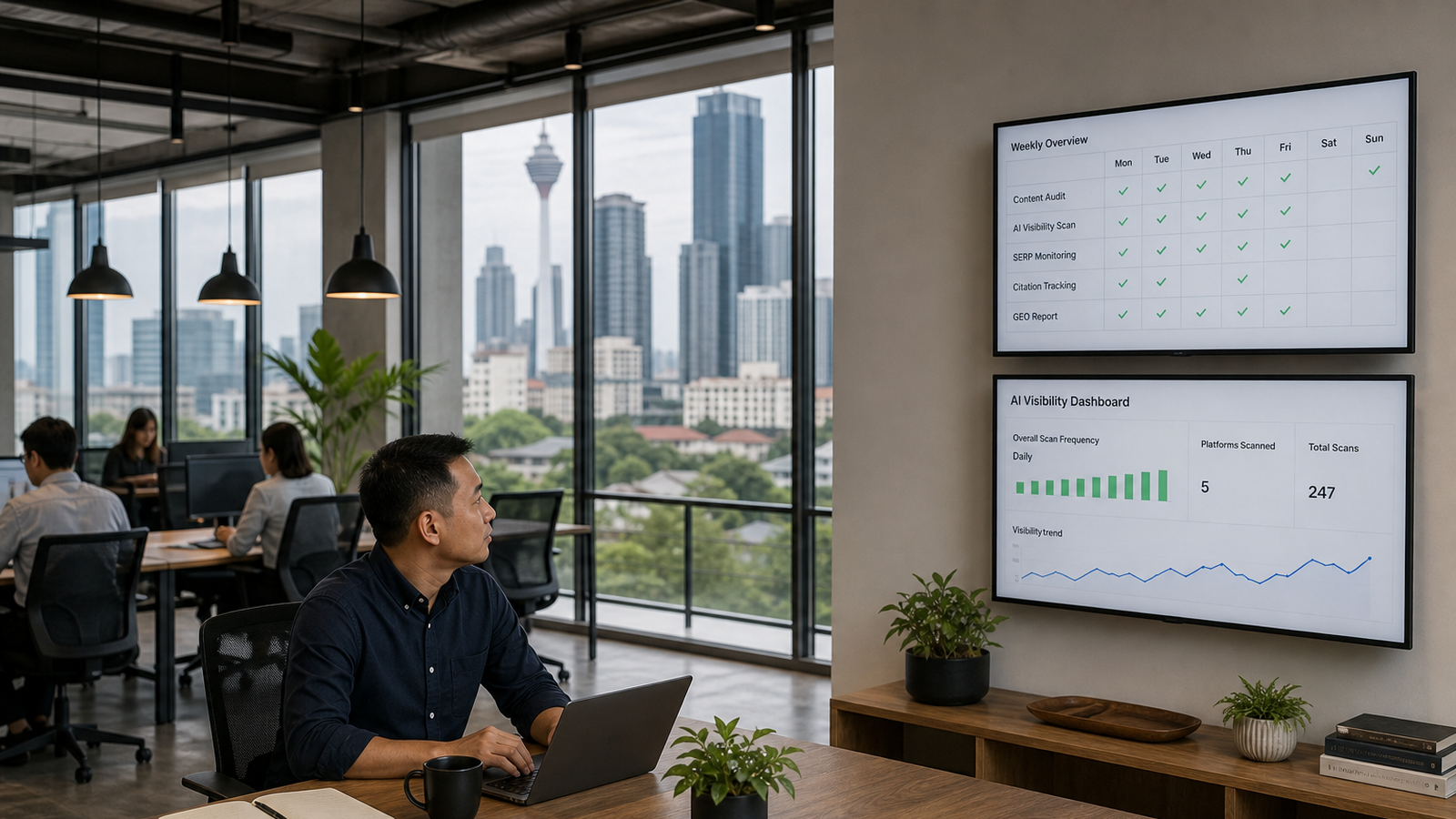
Scan daily, report weekly, decide monthly. That is the cadence Geo One runs for clients: AI agents check visibility across ChatGPT, Claude, Gemini and Perplexity every day, a report goes out once a week, and the plan gets reviewed once a month. Daily scanning catches movement while it is still fixable. Weekly reporting matches the pace a two-to-fifty-person firm with no in-house marketer can actually act on. Monthly is when you decide whether to keep spending.
What does one AI visibility scan actually produce?
A scan is a list of buyer questions put to each AI engine, plus a record of what came back. For every prompt, four things are logged: whether your business was named, where it sat in the answer, whether the description was accurate, and which sources the engine cited.
For a dental practice in Cheras, tracked prompts might include "dentist near Cheras that does root canal", "berapa kos rawatan gigi di Kuala Lumpur" and "best family dentist in KL". Three phrasings, two languages, four engines, twelve answers from one idea. That volume is why this is agent work rather than something a receptionist does on a Friday afternoon.
The cited sources matter as much as the mention. Say Perplexity answers a question about your category using two directories and a news article. Those three pages are your route in. That list drives the citation work; it is not a vanity metric. Our companion piece on what our AI agents actually check goes through the full list.
The scans roll up into a visibility score. It is an internal measure, not a number published by OpenAI, Anthropic, Google or Perplexity, so it only means something against its own baseline. In one Geo One account, a pet care brand in Selangor, the score started at zero, meaning the brand was named in none of its tracked prompts on any engine, and began registering mentions within roughly two weeks. That is our own dashboard data, not an external benchmark, and the useful part is the direction and the speed rather than the figure itself.
Why scan daily if you only act weekly?
Because AI answers are not stable. Ask the same question twice in one day and you can get two different sets of businesses named. A single scan showing you absent might be a real gap, or it might be run-to-run variation. Daily sampling gives you a pattern instead of a snapshot, and a pattern is the only thing worth acting on.
The second reason is access. Your website can stop being readable by AI crawlers without anyone touching your content. Most CDNs and security layers now ship with controls for AI crawlers, and those settings can change when you migrate hosting, switch plans or add a domain. A change made for speed or security can take you out of the answers entirely. If your site sits behind Cloudflare, bot and crawler handling is documented in the Cloudflare developer documentation, check what your own settings are rather than assuming the default is open.
A daily scan catches that kind of blockage within twenty-four hours. A monthly scan leaves you invisible for weeks before anyone notices, and if the block coincided with a campaign, you will spend that month blaming the wrong thing.
What breaks the weekly cadence
Three things should not wait for the report:
- You vanish from a prompt you have appeared in consistently for a week. Check the site is reachable before assuming the engine changed its mind.
- The description is wrong in a way that costs money, wrong address, wrong practice areas, hours that say you are closed.
- A competitor turns up in a cited source you could also be listed in. That is a directory or publication you can act on this week, not next month.
Everything else, position shifts, single-engine wobble, a prompt that comes and goes, belongs in the weekly report, where it can be read as a trend.
What the weekly report should tell you
A weekly report that only shows a score has failed. Four things are worth a business owner's ten minutes:
- Which prompts you appeared in this week, and which you lost. Named prompts, not a percentage.
- Engine-by-engine differences. Appearing in Perplexity but not in ChatGPT is a different problem from appearing in neither, and it points at different fixes.
- New cited sources. Any page an engine started citing for your category is a target for the coming week.
- One decision. What is being worked on next, and why that and not something else.
If your report cannot be read in the time it takes to finish a kopi, the cadence is wrong for the business, not for the agency.
What the monthly review decides
The monthly meeting is not a longer version of the weekly report. It answers three questions.
First: is the prompt set still right? A clinic that added implants, a law firm that started taking probate work, a tuition centre opening a second branch in Puchong, each of those changes what buyers type. A tracked prompt list that has not moved in six months is probably tracking last year's business.
Second: did the work move anything? Citation building, directory cleanup and schema changes do not show up the day they are done. A month is roughly the shortest window in which you can look at a change and the score together without reading noise as progress. Even then, treat it as correlation: a new mention appearing three weeks after a directory listing went live is consistent with the listing working, not proof of it.
Third: is the spend still justified? Most SME retainers in this category sit somewhere between RM500 and RM2,000 a month. The honest test is whether the prompts your buyers actually use are trending towards mentions, and whether the enquiries you can trace to AI answers, people who say "ChatGPT recommended you", are non-zero and rising. If neither has moved in three monthly reviews, the plan is wrong, and no increase in scan frequency fixes that.
Does the cadence change by business type?
The reporting rhythm holds, but the volume behind it does not.
A dental or aesthetic clinic in the Klang Valley competes in crowded prompts with dozens of plausible answers, so results move often and there is always something to act on. A freight forwarder or a specialist trader may have only eight or ten prompts a real buyer would ever type. Those answers are drawn from a thin pool of sources, which makes them more volatile, not less. Both benefit from daily sampling for the same reason: you need enough runs to tell a change from a wobble.
Solo professionals, insurance agents, trainers, consultants, have a different exposure. When the person and the business are the same entity, an inaccurate description is a reputation problem as much as a marketing one, so the accuracy field in the scan matters more than position.
If you are doing this without an agency
Manual checking at a sensible cadence beats an expensive tool you stop opening. Pick five prompts your buyers would genuinely type, two engines, once a month. Paste the full answer into a dated spreadsheet, not a summary, the whole thing, including the source links. Six months of that is a real record, and it is enough to spot the two failures that matter most: you are never named, or you are named wrongly.
What you give up is variance handling and speed. With one sample a month you cannot tell a real drop from a coin flip, and a crawl block can sit undetected for up to thirty days. That trade is defensible for a solo consultant. It is harder to defend for a clinic spending on ads that point at a site the engines cannot read.
What a scan does not do
The agents record what each AI engine says and flag changes. They do not control what those engines say. No provider decides where you appear or how you are described inside ChatGPT, Claude, Gemini or Perplexity, those are the platforms' own outputs, and they shift. What the work improves is the quality and reach of the signals those systems draw on: cited sources, accurate directory listings, and structured content on your own site.
Work with Geo One: explore our services or get in touch to get started.
Frequently asked questions
How often do you check whether my business shows up in AI answers?
Scans run daily, reports go out weekly, and the plan is reviewed monthly. Daily scanning catches movement while it is still fixable. Weekly reporting matches the pace a two to fifty person firm can actually act on, and monthly is when you decide whether to keep spending. AI agents do the daily checking across ChatGPT, Claude, Gemini and Perplexity.
What do I actually get from a single scan?
A scan is a list of buyer questions put to each AI engine, plus a record of what came back. For every prompt we log four things: whether your business was named, where it sat in the answer, whether the description of you was accurate, and which sources the engine cited to build that answer. The cited sources matter as much as the mention, because they are your route in.
Why scan every day if I only read a report once a week?
Because AI answers are not stable. Ask the same question twice in one day and you can get two different sets of businesses named. A single scan showing you absent might be a real gap, or it might be run to run variation. Daily sampling gives you a pattern instead of a snapshot, and a pattern is the only thing worth acting on.
Which AI engines and languages do you track?
We check ChatGPT, Claude, Gemini and Perplexity, and prompts are tracked across multiple languages. For a dental practice in Cheras, tracked prompts might include "dentist near Cheras that does root canal", "berapa kos rawatan gigi di Kuala Lumpur" and "best family dentist in KL". One question in three languages across four engines is twelve answers, which is why this is agent work rather than a manual task.
Can my website stop being visible to AI without me changing anything?
Yes. Your website can stop being readable by AI crawlers without anyone touching your content. Cloudflare has been tightening its default handling of AI crawlers, and sites that were migrated or newly onboarded can end up blocking AI agent traffic at the edge without the owner knowing. If your site sits behind Cloudflare, check the AI crawl control settings.

Bernard Leong
Co-Founder, Geo One
Nearly 20 years across energy, capital strategy and applied AI, including large-scale operational data at BP. Founded SkillsMe and Cryptrain.
More about the teamCheck Your AI Visibility
See how AI platforms currently view your business with a free scan.
Free AI Scan