AI visibility scanning in Malaysia: what our AI agents actually check
Co-Founder, Geo One
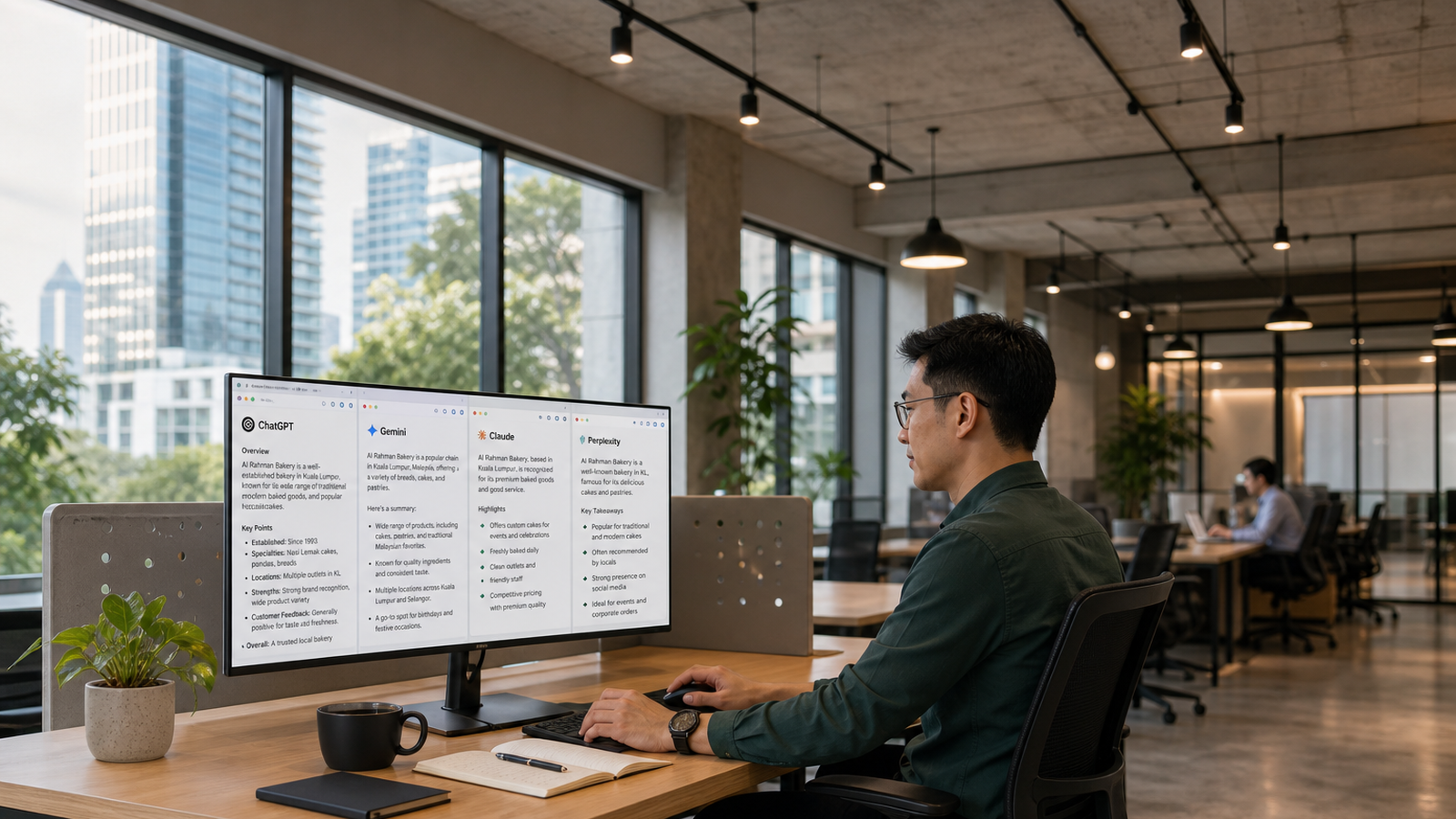
An AI visibility scan checks four things: whether AI crawlers can reach your website, whether ChatGPT, Claude, Gemini and Perplexity name your business when buyers ask questions in your category, whether the description they return is accurate, and which third-party sources get cited instead of you. Geo One runs these scans from Kuala Lumpur using its own AI agents. Monitoring runs daily across the four engines, and clients get a scan, fix and report cycle every week.
A scan is a measurement, not a fix. It produces evidence and a queue of corrections, nothing more. This piece explains what the agents look at, in what order, and, just as importantly, what the output cannot tell you. It is written for owners and practice managers of Malaysian firms with 2 to 50 staff: clinics, dental and veterinary practices, law and accounting firms, property agencies and tuition centres.
Why scan at all instead of checking Google rankings?
Because buyers are asking assistants, not only search boxes. A keyword ranking report says nothing about what an assistant says when a client's operations manager types "best freight forwarder near KL Sentral for LCL shipments" into ChatGPT.
The other reason is that answers move. Ask the same question twice and you may get two different lists. One manual check tells you almost nothing. Repeated checks, run the same way, on the same prompts, across the same four engines, start to show a pattern. That repetition is the whole reason the work is handled by agents rather than a person opening tabs on a Monday morning.
The four checks below run in order, and the order is not cosmetic. If your site is unreachable to a search-time agent, a prompt scan will show you absent from answers and you will conclude you have an authority problem. You have a plumbing problem. Fix check one before you read anything into checks two to four.
Check one: can the AI crawlers actually read your site?
This is the first pass, and it's the one that most often comes back broken. There are two separate groups of bots, and confusing them is the common mistake. Training crawlers collect content for model training. Search-time agents fetch pages live when someone asks a question, and those are the ones that decide whether you can be cited today.
Block the training bot and you may silently block the search agent too. Allowing ClaudeBot while leaving Claude-SearchBot and Claude-User blocked still leaves Claude's live web path unable to read you. Anthropic documents its crawler names in the Anthropic documentation, and OpenAI does the same in the OpenAI platform docs.
The second place to look is your content delivery network. Cloudflare's AI Crawl Control settings can block AI crawlers at the edge before they ever reach your robots.txt, and the defaults have changed for newly onboarded domains. If your site was built or migrated recently, check the panel rather than assuming. The controls are described in the Cloudflare developer docs. We wrote about this shift in more detail in what changed in GEO in 2026.
Check two: which prompts get run, and in which language?
The agent doesn't run brand-name searches. Searching your own company name proves little, because assistants can usually find a named business. What matters is the question a buyer asks when they don't know you exist yet.
So the prompt set is built from real buying language: "corporate secretarial firm in KL for a Sdn Bhd", "paediatric dental clinic that takes company insurance", "conveyancing lawyer near Damansara". Prompts are fixed once agreed and re-run unchanged. Changing the wording mid-engagement makes the trend line meaningless, which is the quiet failure in most visibility dashboards, the number moves because the question moved.
For a Malaysian firm that also gets enquiries in Bahasa Malaysia or Mandarin, the same questions get run in those languages, because the sources an engine pulls from can differ by language. That's a separate tracking job, and we've explained how the reporting works in our guide to Bahasa Malaysia AI visibility tracking.
Check three: what does the answer actually say about your business?
Being named in an answer is not the same as being described correctly. The scan records the full text of every response that includes a business name, then checks three things: whether the description matches what the business actually does, whether any claim, fees, services, locations, credentials, is wrong or outdated, and whether the tone of the description would reassure or worry a prospective client.
Wrong descriptions matter because buyers act on them. A conveyancing lawyer described as handling criminal law, or a dental clinic listed in the wrong part of KL, loses enquiries to the inaccuracy rather than to a competitor. The scan flags these so they can be traced to their source: usually a third-party directory, an old press mention, or a Wikipedia-style entry that has not been updated.
Check four: which third-party sources are being cited instead of you?
When an assistant answers a category question, it pulls from somewhere. The scan identifies which sources, directories, review platforms, news sites, industry bodies, are being cited for businesses in your category. If those sources don't mention you, or mention you with outdated information, that is where the correction work starts.
This is not the same as link building for Google. The question is not whether a site links to you but whether the text on that site says something an assistant would retrieve. A well-placed paragraph in a trusted local directory that accurately describes your practice area and location is more useful than a backlink from an unrelated site.
What the scan cannot tell you
Three limits, stated plainly, because no dashboard will state them for you.
It cannot tell you how many people asked that question. No engine publishes prompt volume by category or by country. Any figure you are shown for "monthly AI searches in Malaysia" is extrapolated from Google keyword data and should be read as a guess.
It cannot tell you whether being named produced an enquiry. Assistant referrals frequently arrive as direct traffic, a saved phone number, or a walk-in. Attribution here is weak for everyone, and we would rather say so than draw a line on a chart.
It cannot promise that one run is reproducible. Personalisation, account memory, location and model updates all move the answer. That is why a single run is treated as one data point, not a verdict, and why the scan runs daily rather than monthly.
For the same reason, we don't report a single visibility score out of 100. Four different failure modes, blocked crawler, absent from answers, present but misdescribed, absent from the sources being cited, need four different fixes. Compressing them into one number hides which one you actually have.
Geo One is a GEO and AEO agency based in Kuala Lumpur, serving Malaysian SMEs that want to be found and accurately described when buyers use AI assistants. The scan described above is the starting point for all client engagements.
Frequently asked questions
Check one: can the AI crawlers actually read your site?
This is the first pass, and it's the one that most often comes back broken. There are two separate groups of bots, and confusing them is the common mistake. Training crawlers collect content for model training. Search-time agents fetch pages live when someone asks a question, and those are the ones that decide whether you can be cited today.
Check two: which prompts get run, and in which language?
The agent doesn't run brand-name searches. Searching your own company name proves little, because assistants can usually find a named business. What matters is the question a buyer asks when they don't know you exist yet.
Bernard Leong
Co-Founder, Geo One
Nearly 20 years across energy, capital strategy and applied AI, including large-scale operational data at BP. Founded SkillsMe and Cryptrain.
More about the teamCheck Your AI Visibility
See how AI platforms currently view your business with a free scan.
Free AI Scan