Who checks the AI agents running your visibility scans?

Co-Founder, Geo One
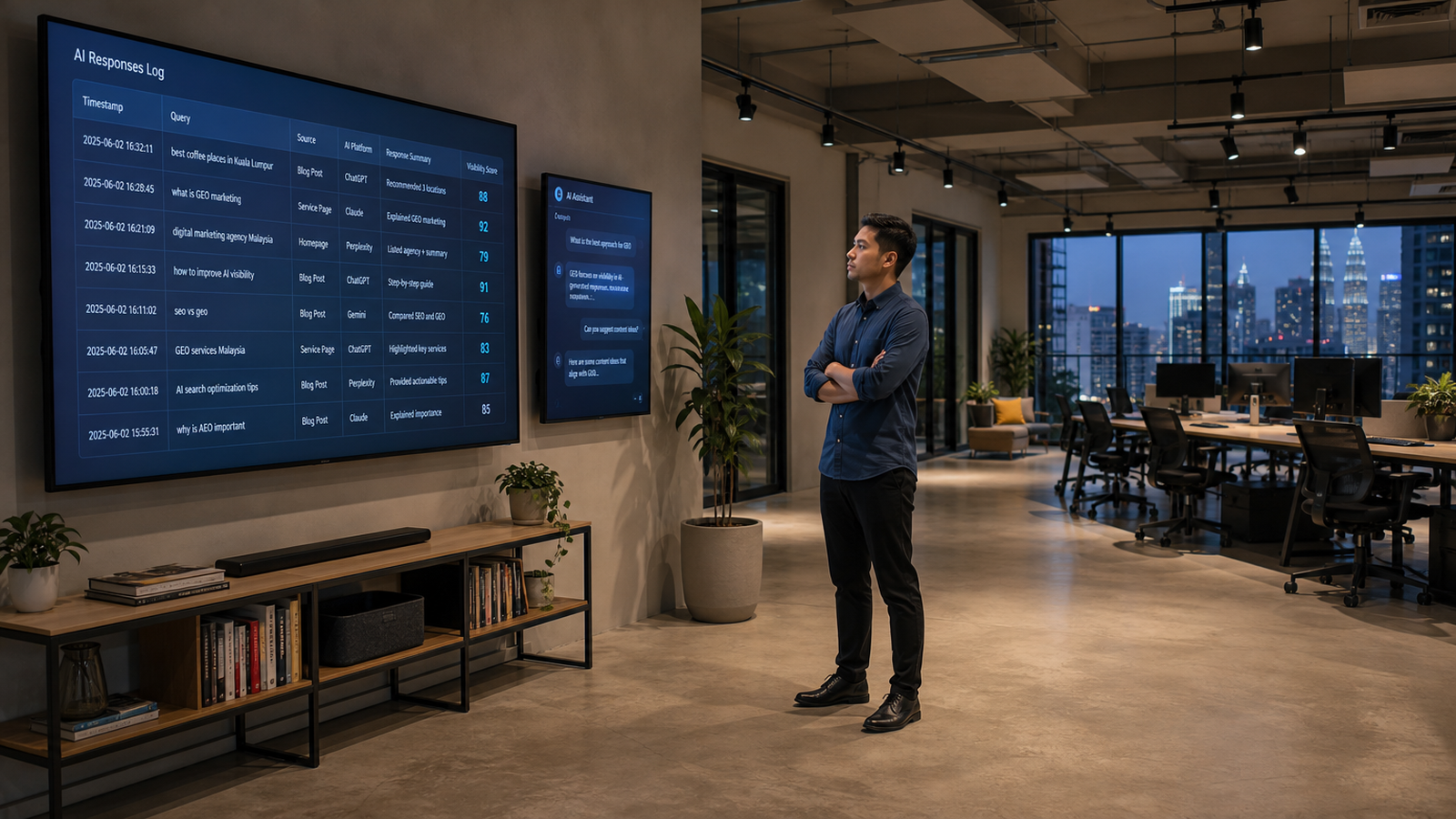
Short answer: a person should check them, and you should be able to see who that person is. An AI agent used for AI visibility scanning does one narrow job. It asks assistants such as ChatGPT, Claude, Gemini and Perplexity the questions your buyers ask, records what comes back, and flags what changed. That's useful. It's also where things can quietly go wrong: the wrong prompts, a misread answer, or content published without anyone looking. So before you pay anyone to run scans for you, ask who reads the answers, who chooses the prompts, and whether anything goes live without a person approving it.
This is written for owners and practice managers of Kuala Lumpur professional services firms with 2 to 50 staff, such as clinics, law and accounting firms, tuition centres and property agencies. Disclosure: it comes from Geo One, a Generative Engine Optimisation (GEO) and Answer Engine Optimisation (AEO) agency in Kuala Lumpur that uses its own AI agents for scanning. The questions below apply to us as much as to any other provider.
What does an AI visibility scanning agent actually do?
A scanning agent is a program that asks questions and keeps the receipts. On each run it sends a fixed list of buyer prompts to each assistant and saves the full answer. It then notes whether your business is named, how it's described and who else appears. Our main guide covers what our AI agents actually check during a scan, so we won't repeat that list here.
What matters for this piece is what the agent doesn't do. It doesn't decide which prompts matter to your business. It doesn't know whether a description of your firm is accurate. And it can't tell your clinic apart from a similarly named one in Penang unless someone has told it what to look for. Those are judgement calls, and judgement is the part a person has to own.
What does a real AI visibility scan result look like?
Our own weekly scan asks ChatGPT, Claude, DeepSeek, Gemini and Perplexity the same list of buyer questions and records whether Geo One is named. The agent produces a count. It can't tell you what the count means. A person reading the answers can. In one scan, Geo One was named when the question was "top AI visibility agencies in Kuala Lumpur". It wasn't named for "best generative engine optimisation agency in Kuala Lumpur". A buyer may see those two questions as nearly the same shortlist. The assistants did not treat them that way in this scan.
That is one observation, not a rule. In this scan, Geo One appeared for one prompt and not the other. That is a reason to test the variants your buyers actually use, and to read your scan results answer by answer rather than as one score. It is not evidence that wording alone decides visibility, because assistants can also answer the same question differently from one day to the next. That is also why how often your scans run matters. A raw score tells you something moved. Reading the saved answers shows where the gap sits.
Who checks Geo One's agents?
A person, at two points. Every piece of content our agents draft is read and approved by a member of the Geo One team before it goes anywhere, and then the client approves it before it is published. Nothing our agents write goes live on a client's site without both approvals, and every approval is recorded against the draft. Scan results are read by the same team before they go into a client's report.
How can you test your own wording?
You don't need a provider for a first look. Pick five ways your clients describe what you do, in the words they use rather than the words on your brochure. Ask each one to two or three assistants. For each answer, write down:
- the exact prompt and the date
- whether your firm is named, and if so, whether the details are right (address, services, hours)
- which competitors are named instead
- whether a similarly named business has been mixed up with yours
Repeat a week later. If an answer changes between runs, you've learned that one run is not a result. A provider's scan should show you the same things, only at larger scale.
What should a reviewer check in every scan?
"A person reads the answers" is only worth something if the reading has pass criteria you can observe. These are the checks to expect, and the evidence that shows each one was done:
| Check | What you should be able to see |
|---|---|
| The business named is actually yours | A note per answer confirming a match on more than the name, such as location or service |
| Descriptions are accurate | Wrong details flagged against your real address, services and opening hours |
| Prompts reflect real buyers | The full prompt list, including Bahasa Malaysia or Chinese versions if clients search that way |
| Counts can be traced | Every "named" answer links to a saved full answer |
| Changes are explained | A short written reading of what moved and what it might mean, not only a number |
If a provider can't show you one of these, ask how that check is done instead.
What should you ask before someone runs AI visibility scans for you?
Ask these five questions, and get the answers in writing:
- Who reads the answers? You want a named person or a named role, not just a dashboard. Ask how they make sure an answer about a similarly named business isn't counted as yours.
- Who chose the prompts, and can you see the list? Check it against how your own clients actually ask, including in Bahasa Malaysia or Chinese if that's how some of them search.
- Do you get the full saved answers, or only a score? A score alone can't be checked. Saved answers show you the exact wording and which competitors were named instead of you.
- Does anything get published or changed on your site without a person approving it? A good answer names who approves and how you'll see the change before it goes live.
- Is AI-generated content labelled, and what information about your business goes into AI tools? A scan asks public buyer questions, so it shouldn't need client names, patient details or case files. If it does, ask why, and how they handle it under Malaysia's Personal Data Protection Act (Chambers summarises the 2024 changes).
A provider who can answer all five plainly is one you can hold to account. If the answers are vague, ask for an example from a real scan before you sign.
Frequently asked questions
What does a scanning agent actually do?
It's a program that asks questions and keeps the receipts. On each run it sends a fixed list of buyer prompts to each assistant and saves the full answer. It then notes whether your business is named, how it's described and who else appears. Our main guide covers [what our AI agents actually check during a scan](https://geoone.my/blog/insights/ai-visibility-scanning-malaysia), so we won't repeat that list here.
Who checks Geo One's AI agents?
A member of the Geo One team reads and approves every draft before it goes anywhere, and the client then approves it before it is published. Nothing our agents write goes live without both approvals.

Bernard Leong
Co-Founder, Geo One
Nearly 20 years across energy, capital strategy and applied AI, including large-scale operational data at BP. Founded SkillsMe and Cryptrain.
More about the teamCheck Your AI Visibility
See how AI platforms currently view your business with a free scan.
Free AI Scan